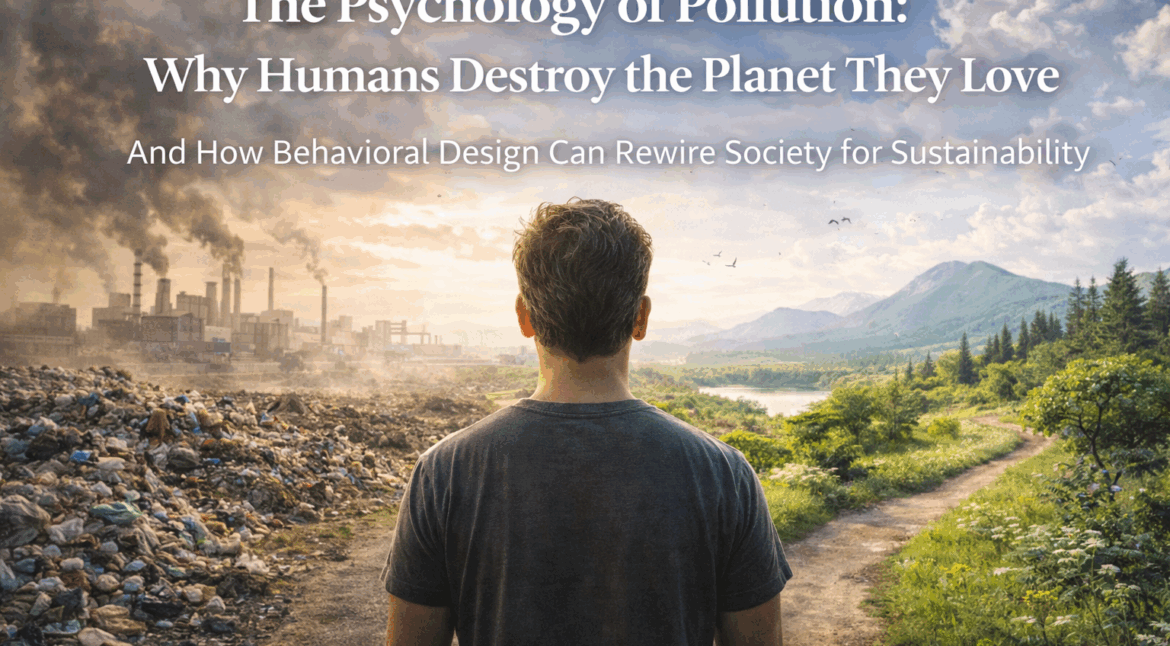
The Psychology of Pollution: Why Humans Destroy the Planet They Love
And How Behavioral Design Can Rewire Society for Sustainability
The Problem Is Not a Lack of Love — It Is a Mismatch Between Mind and System
Most people do not want polluted rivers, toxic air, or plastic-filled oceans.
They love nature.
They worry about the future.
And yet, collectively, humanity continues to destroy the very planet it claims to care about.
This is not because humans are evil.
It is because human psychology is being asked to function inside systems it was never designed for.
Why Knowledge Alone Doesn’t Change Behavior
People know pollution is harmful.
They know climate change is real.
They know waste should be reduced.
Yet knowing does not equal doing.
Psychological research shows that behavior is driven less by information and more by:
- Convenience
- Habit
- Social norms
- Immediate rewards
- Perceived effort
When sustainable choices feel inconvenient or invisible, they are ignored — even by people who care.
The Tragedy of Psychological Distance
Pollution feels distant.
Its consequences are delayed.
The damage often happens somewhere else, to someone else, sometime later.
The human brain evolved to respond to immediate threats — not slow, invisible ones.
This psychological distance creates emotional disengagement.
We care in theory, but not in action.
Why Guilt and Fear Don’t Work
Many environmental campaigns rely on fear, guilt, or moral pressure.
These emotions trigger defensiveness, not cooperation.
When people feel blamed, they shut down.
When responsibility feels overwhelming, avoidance becomes the coping strategy.
Sustainability framed as sacrifice rarely scales.
Behavioral Design: Changing the Environment Around the Mind
Behavioral design flips the approach.
Instead of asking people to be better, it designs systems that make better behavior natural.
This includes:
- Making sustainable choices the default
- Reducing friction for good behavior
- Providing immediate feedback and rewards
- Using social proof to normalize responsibility
When systems align with psychology, behavior changes effortlessly.
Why Humans Pollute What They Love
Humans destroy the planet not out of hatred — but out of disconnection.
Modern life separates:
- Consumption from consequence
- Action from impact
- Comfort from cost
When people don’t see the results of their actions, responsibility fades.
Pollution becomes an abstract problem instead of a personal one.
How EcoGraha Rewires Behavior
EcoGraha is built on behavioral intelligence.
It reconnects action with outcome by:
- Making waste flows visible and traceable
- Rewarding responsible behavior through incentives
- Turning sustainability into participation, not punishment
- Integrating education with daily life
When people see impact, they care.
When they are rewarded, they participate.
When systems are fair, trust returns.
From Awareness to Alignment
The future of sustainability is not about awareness.
It is about alignment.
Alignment between:
- Human psychology
- Economic incentives
- Technological systems
- Environmental goals
When these align, sustainability stops feeling like effort.
It becomes normal behavior.
The Deeper Truth
Humans do not need to love the planet more.
They already do.
They need systems that honor how the human mind actually works.
EcoGraha exists to design those systems —
where caring becomes action,
and action becomes culture.