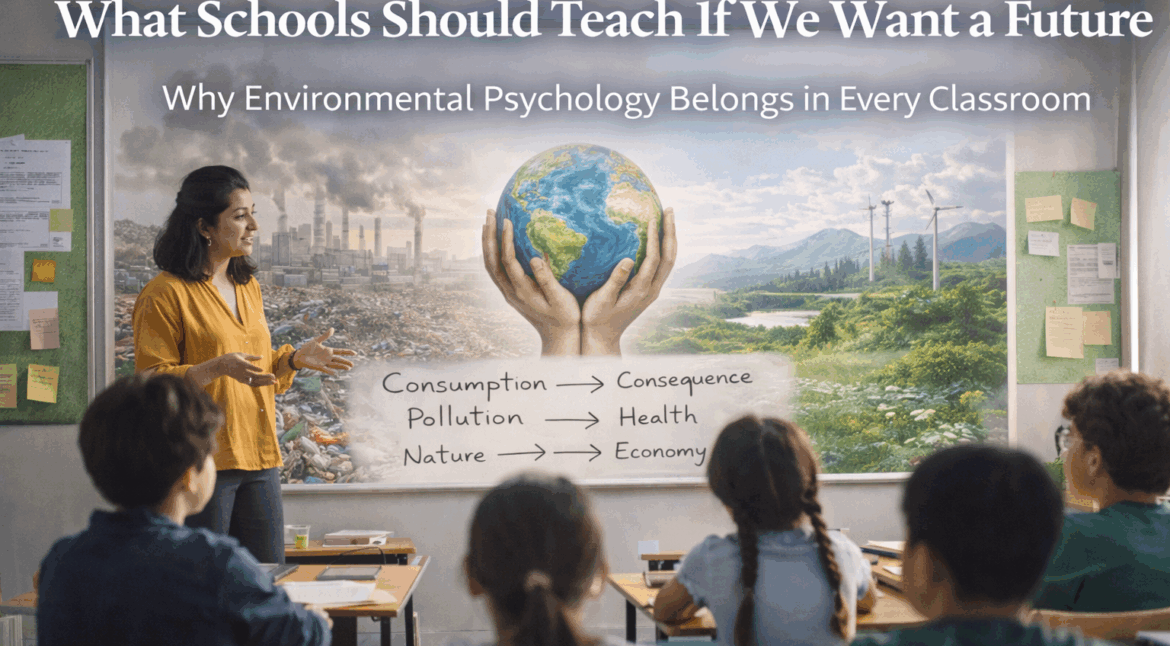
What Schools Should Teach If We Want a Future
Why Environmental Psychology Belongs in Every Classroom
Education Shapes Not Just Careers — It Shapes Civilizations
Schools have taught humanity how to read, calculate, compete, and consume.
They have prepared students for jobs, exams, and economic success.
But they have largely ignored one critical question:
How should humans live responsibly on a finite planet?
As a result, we graduate intelligent minds into systems they do not understand — systems that quietly damage the world sustaining them.
Why Environmental Education Has Failed So Far
Most schools already teach “environmental studies.”
Students memorize:
- Definitions of pollution
- Types of ecosystems
- Causes of climate change
And then they return to lives shaped by convenience, consumption, and disconnection.
Knowledge without behavior change is incomplete education.
The Missing Subject: Environmental Psychology
Environmental psychology studies how human behavior interacts with natural and built environments.
It asks questions schools rarely touch:
- Why do people litter even when bins exist?
- Why do habits override values?
- How do social norms shape environmental behavior?
- What motivates long-term responsibility?
Without understanding the mind, sustainability remains theoretical.
Children Are Not the Problem — Systems Are
Children are naturally empathetic.
They care about animals, plants, and fairness.
But systems teach them something else:
- Speed matters more than impact
- Convenience beats responsibility
- Someone else will fix the mess
Education must counter these invisible lessons.
What Environmental Psychology Teaches Differently
Environmental psychology does not moralize.
It designs.
It helps students understand:
- How habits form and change
- Why incentives matter
- How collective behavior emerges
- Why systems shape choices
Students stop asking, “Who is at fault?”
They start asking, “How do we design better systems?”
From Subjects to Life Skills
Environmental psychology transforms sustainability from a topic into a life skill.
Students learn:
- Responsible consumption
- Systems thinking
- Civic participation
- Long-term consequence awareness
These skills apply far beyond ecology.
They create better citizens, leaders, and communities.
How EcoGraha Reimagines Education
EcoGraha treats education as infrastructure.
Not an add-on.
Through real-world systems, students see:
- Where waste goes
- How energy is created
- How behavior affects outcomes
- How participation generates value
Learning becomes experiential.
Responsibility becomes visible.
Education as Preventive Climate Policy
No regulation is more powerful than an informed generation.
Teaching environmental psychology early:
- Reduces enforcement costs
- Builds cultural responsibility
- Creates long-term sustainability
Prevention is always cheaper than cleanup.
The Education That Shapes the Future
The future will not be saved by smarter machines alone.
It will be shaped by wiser humans.
If we want a future, we must teach for it.
EcoGraha exists to make that education real —
not in textbooks,
but in everyday life.