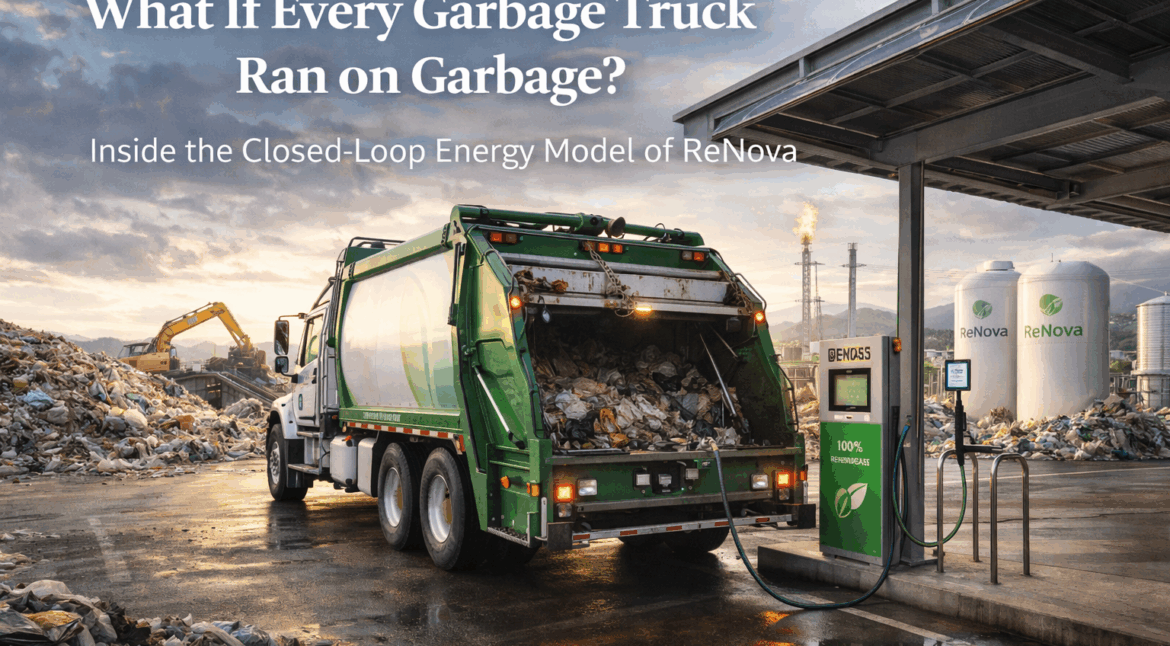
What If Every Garbage Truck Ran on Garbage?
Inside the Closed-Loop Energy Model of ReNova
The Most Logical Energy Idea We Somehow Ignored
Garbage trucks are among the most fuel-hungry vehicles in any city.
They run every day.
They stop and start constantly.
And they burn fossil fuels to collect waste — the very thing causing pollution.
EcoGraha asked a simple question:
Why are we burning oil to move garbage, when garbage itself is fuel?
Understanding the Energy Inside Waste
Organic waste is not useless.
Food scraps, agricultural residue, and biodegradable waste contain stored chemical energy.
When processed correctly, this energy can be released as:
- Biogas
- Bio-CNG
- Biodiesel
- Electricity
For decades, this energy has escaped into the atmosphere as methane — one of the most dangerous greenhouse gases.
ReNova captures it instead.
The Closed-Loop Energy Concept
A closed-loop system means nothing leaves the system unused.
In ReNova’s energy loop:
Waste → Energy → Transportation → Waste Collection
Organic waste is processed in biogas and biofuel plants.
The fuel powers garbage trucks and municipal fleets.
Those trucks collect more waste.
The loop feeds itself.
Why Garbage Trucks Are the Perfect Starting Point
Garbage trucks operate on predictable routes and schedules.
They return to the same depots every day.
This makes them ideal for alternative fuels.
ReNova’s model enables:
- Local fueling stations at waste facilities
- Reduced dependency on diesel imports
- Lower operating costs for municipalities
- Significant emission reductions
Energy becomes local.
Logistics become cleaner.
The Environmental Impact
Every truck running on waste-derived fuel:
- Prevents methane leakage from landfills
- Reduces diesel combustion emissions
- Lowers particulate pollution in cities
- Contributes to carbon credit generation
The impact compounds daily.
Cities don’t just manage waste — they clean the air while doing it.
Economic Sense, Not Environmental Charity
This model works because it is economically rational.
Fuel is one of the highest recurring costs in waste management.
Replacing imported diesel with locally produced biofuel:
- Stabilizes municipal budgets
- Protects against fuel price volatility
- Keeps money circulating locally
- Creates green jobs
Sustainability becomes a cost-saving measure.
Scaling Beyond Garbage Trucks
Once proven, the same energy loop can power:
- Public buses
- Municipal service vehicles
- Industrial equipment
- Local power grids
Waste stops being a burden.
It becomes infrastructure.
The Future Runs on What We Throw Away
Fossil fuels are finite.
Waste is continuous.
Cities will always generate it.
The smartest cities will power themselves with it.
When garbage trucks run on garbage,
waste management stops being a cost.
It becomes a self-sustaining engine.
ReNova exists to close that loop.