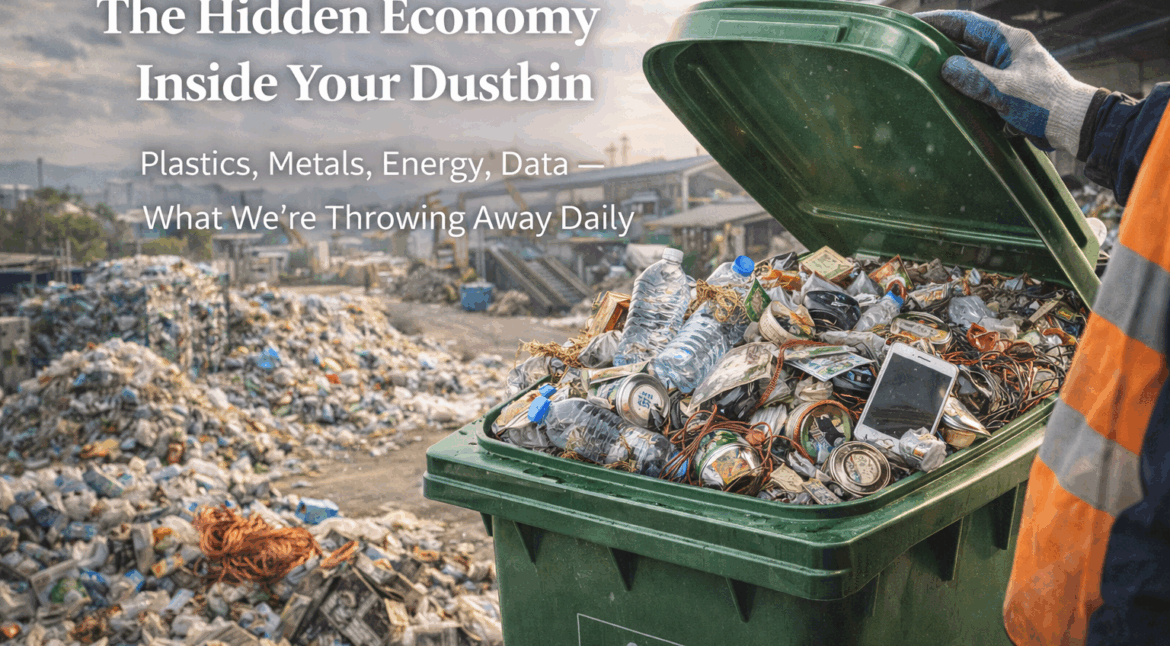
The Hidden Economy Inside Your Dustbin
Plastics, Metals, Energy, Data — What We’re Throwing Away Daily
Every Day, We Discard More Wealth Than We Realize
The average dustbin looks boring.
A plastic wrapper.
A food scrap.
A broken item.
Yesterday’s newspaper.
But look closer.
You are looking at a mini economy.
One that operates invisibly, informally, and inefficiently — or not at all.
Plastics: Solid Oil We Treat as Trash
Plastics are not “cheap.”
They are fossil fuels in solid form.
Every plastic item represents:
- Extracted crude oil
- Energy-intensive processing
- Industrial labor
- Transportation emissions
When plastics are dumped or burned, we destroy all that embedded value.
In a circular system, plastics become:
- Recycled raw material
- Construction inputs
- Fuel substitutes
Your dustbin contains oil.
Metals: Mining the Bin Instead of the Earth
Metals never lose their value.
Aluminum, steel, copper, and rare metals can be recycled endlessly.
Yet they are routinely thrown away.
Recovering metals from waste:
- Consumes far less energy than mining
- Reduces environmental destruction
- Creates local industrial jobs
Every landfill is an unrecognized urban mine.
Organic Waste: Energy We Let Rot
Food waste is not harmless.
When dumped in landfills, it releases methane — a greenhouse gas far more potent than CO₂.
But organic waste also holds energy.
Through biogas and biofuel systems, it can become:
- Cooking gas
- Vehicle fuel
- Electricity
- Organic fertilizer
We are literally throwing fuel into the ground.
Data: The Most Invisible Resource of All
Waste does not just contain materials.
It contains information.
Patterns of consumption.
Seasonal trends.
Community behavior.
When captured responsibly, waste data helps cities:
- Optimize collection routes
- Reduce costs
- Design better infrastructure
- Prevent future waste
Garbage becomes intelligence.
Why This Economy Stays Hidden
Because it sits at the intersection of:
- Low visibility
- Low social status
- Fragmented responsibility
- Outdated systems
When value is invisible, it is ignored.
When it is ignored, it is wasted.
What Happens When We Make It Visible
EcoGraha exposes the hidden economy inside waste.
By integrating:
- AI-powered sorting
- Transparent tracking
- Energy recovery systems
- Citizen participation incentives
Waste shifts from neglect to recognition.
From burden to asset.
A Simple Realization
We are not running out of resources.
We are running out of systems that recognize them.
The economy you’re looking for isn’t underground.
It’s already in your dustbin.
EcoGraha exists to unlock it.