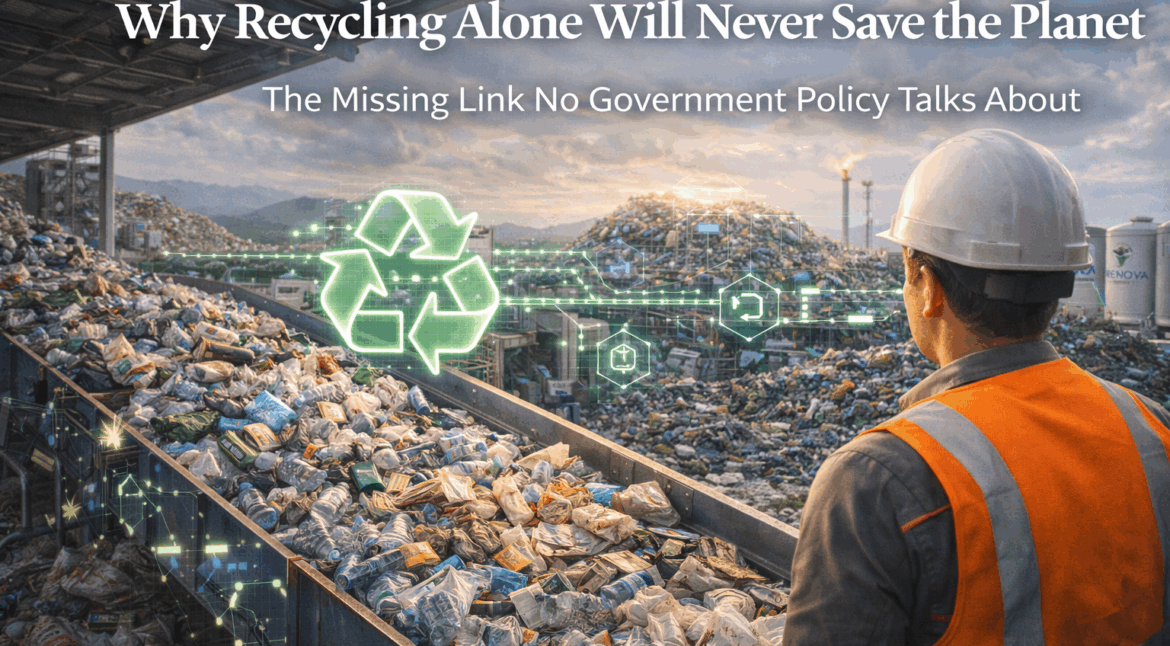
Why Recycling Alone Will Never Save the Planet
The Missing Link No Government Policy Talks About
Recycling Is Important — But It Was Never Meant to Carry the Entire Burden
Recycling has become the world’s favorite environmental solution.
Separate your waste.
Put plastics in one bin.
Paper in another.
Do your part.
And yet, global pollution continues to rise.
Landfills expand.
Oceans fill with plastic.
Emissions keep climbing.
The uncomfortable truth is this:
Recycling alone was never designed to save the planet.
What Recycling Can — and Cannot — Do
Recycling is a downstream solution.
It deals with waste after it has already been created.
At best, recycling:
- Reduces the need for virgin materials
- Saves some energy
- Delays landfill accumulation
At worst, it becomes symbolic — giving society a sense of moral relief without systemic change.
Recycling treats symptoms.
It does not cure the disease.
The Scale Problem No One Likes to Discuss
Global consumption is increasing faster than recycling capacity.
Many materials:
- Cannot be recycled endlessly
- Lose quality after each cycle
- Are too contaminated to process
Even in the best-performing countries, only a fraction of waste is truly recycled.
The rest is burned, exported, or buried.
Recycling cannot outrun exponential consumption.
The Missing Link: System Design
The real issue is not waste behavior.
It is system architecture.
Most modern economies are built on a linear model:
Extract → Produce → Consume → Discard
Recycling is tacked on at the end — like a patch on a fundamentally broken design.
No government policy questions this model.
That is the blind spot.
Why Policies Keep Missing the Point
Policies often focus on:
- Collection targets
- Recycling percentages
- Awareness campaigns
Rarely do they address:
- Product design
- Material lifecycles
- Incentive structures
- Economic feedback loops
Without redesigning how value flows, recycling becomes an obligation — not a solution.
What Actually Works: Circular Systems
Circular systems begin long before waste exists.
They are designed around one principle:
Waste should never be an endpoint.
In a circular economy:
- Products are designed for reuse
- Materials flow continuously
- Energy is recovered
- Outputs always become inputs
Recycling becomes one tool among many — not the hero.
Where EcoGraha Breaks the Pattern
EcoGraha does not ask recycling to solve everything.
It integrates:
- Waste-to-energy systems
- Material recovery at scale
- Behavioral incentives
- Transparent tracking
- Economic value creation
Waste is intercepted, transformed, and reintegrated into the economy.
The system works because it aligns:
- Human behavior
- Economic logic
- Environmental outcomes
The Hard Truth — and the Hope
Recycling is necessary.
It is just not sufficient.
The planet does not need better bins.
It needs better systems.
EcoGraha exists to build them.