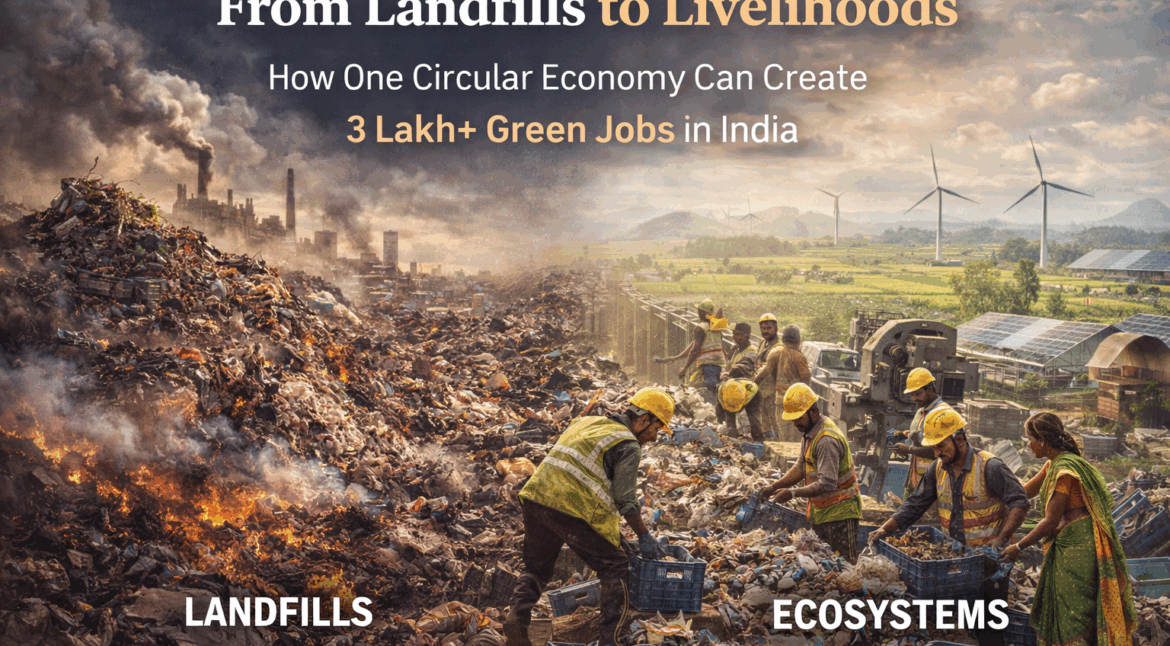
From Landfills to Livelihoods
How One Circular Economy Can Create 3 Lakh+ Green Jobs in India
India’s Waste Crisis Is Also Its Greatest Employment Opportunity
When we talk about waste in India, the conversation usually ends in despair — overflowing landfills, polluted rivers, burning garbage, and overwhelmed municipalities.
But what if we are asking the wrong question?
What if India’s waste problem is not a liability — but a massive, untapped employment engine?
EcoGraha begins with this shift in perspective.
Landfills: Mountains of Lost Opportunity
Every landfill in India is a silent story of wasted potential.
Inside these mountains of garbage lie:
- Energy-rich organic waste
- Plastics that can be converted into fuel or construction material
- Metals valuable to manufacturing industries
- Paper that can be recycled back into the economy
Instead of extracting value, we bury it.
Landfills do not just consume land — they consume jobs, health, and economic possibility.
Why the Linear Economy Fails Employment
The traditional linear economy follows a simple path:
Take → Make → Use → Throw
This model creates temporary consumption but permanent waste.
Jobs created in extraction and manufacturing disappear once resources are exhausted.
Waste, once discarded, creates no further economic activity — only cleanup costs.
The result is job volatility, environmental damage, and rising public expenditure.
The Circular Economy: Jobs That Don’t End
A circular economy works differently.
It designs systems where materials never reach a “dead end.”
Waste becomes:
- Raw material for new products
- Fuel for energy generation
- Input for construction and infrastructure
- Currency for community participation
Every loop in this system creates work.
And because the loop never ends, neither do the jobs.
Where the 3 Lakh+ Jobs Come From
EcoGraha’s circular ecosystem generates employment across multiple layers:
- Waste collection and logistics (drivers, supervisors, coordinators)
- Material recovery and sorting facilities
- Biofuel and waste-to-energy plants
- Eco-construction and recycled manufacturing units
- AI, IoT, and digital governance platforms
- Education, training, and community engagement
These are not informal, unstable jobs.
They are structured, skilled, and future-ready green careers.
Rural India: The Silent Beneficiary
One of the greatest strengths of a circular economy is decentralization.
EcoGraha’s micro-plants and village-level facilities:
- Create local employment
- Reduce migration to cities
- Provide energy and materials locally
- Empower women and youth
Waste processed near its source means income stays within communities.
This is not urban development spilling into villages — it is rural revival from within.
More Than Jobs: Dignity and Stability
Employment is not just about numbers.
It is about dignity, predictability, and purpose.
Circular economy jobs:
- Cannot be outsourced overseas
- Are rooted in local ecosystems
- Grow as cities grow
- Improve public health outcomes
When waste becomes valuable, workers are no longer invisible.
They become key contributors to national resilience.
Why This Matters for India’s Future
India needs employment at scale — but not at the cost of its environment.
The circular economy solves both challenges simultaneously.
It reduces pollution while increasing productivity.
It creates jobs while lowering public spending on cleanup and healthcare.
It turns waste into an asset and citizens into participants.
A Different Kind of Growth Story
India does not need to choose between development and sustainability.
It needs to redesign development itself.
From landfills to livelihoods, the path is clear:
When waste circulates, opportunity multiplies.
EcoGraha is not just creating jobs.
It is building the workforce of a future-proof India.