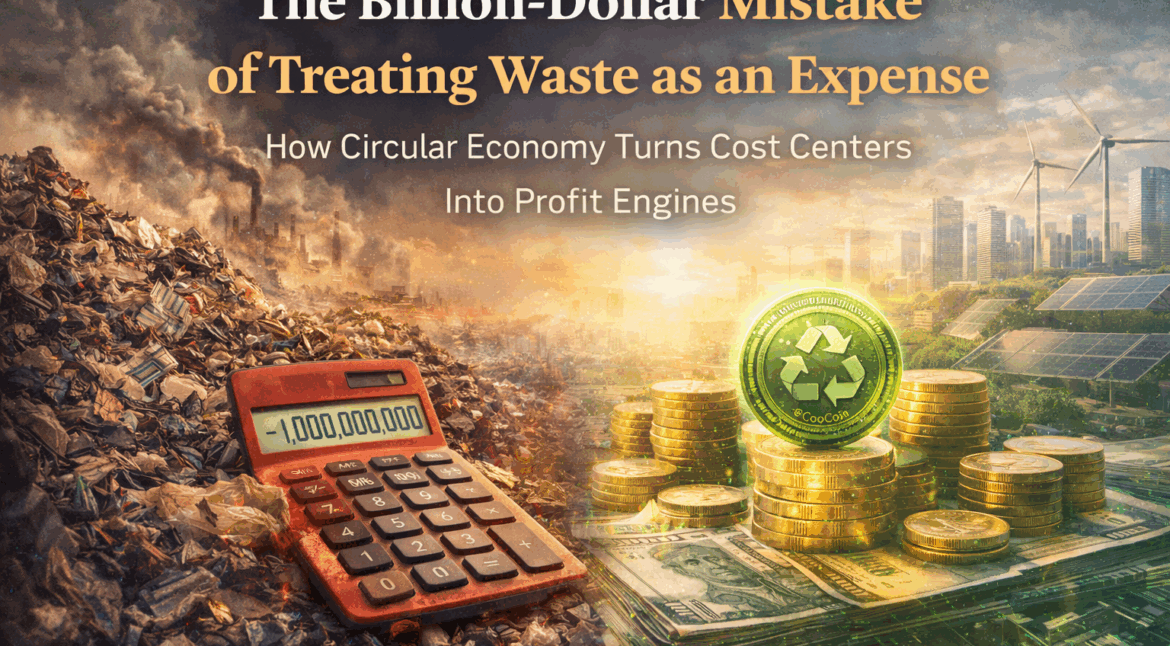
The Billion-Dollar Mistake of Treating Waste as an Expense
How Circular Economy Turns Cost Centers Into Profit Engines
The Accounting Error That Is Quietly Bankrupting the Planet
Across cities, corporations, and governments, waste appears in the same place on every balance sheet:
Expenses.
Collection costs. Transportation costs. Processing costs. Landfill costs. Cleanup costs.
Year after year, trillions are spent globally just to make waste “go away.”
And that is the billion-dollar mistake.
Why Waste Was Never Meant to Be an Expense
In nature, nothing is written off.
What one process discards becomes the raw material for another.
Leaves become soil.
Waste heat becomes energy.
Death feeds life.
Expenses exist only when systems are poorly designed.
Waste is not expensive by nature — it becomes expensive when value extraction stops.
The Linear Economy Accounting Trap
The linear economy follows a familiar logic:
Extract → Manufacture → Consume → Dispose
Value is captured only once — at the point of sale.
Everything after consumption is treated as a liability.
This is why:
- Municipal budgets bleed money on waste
- Corporations externalize disposal costs
- Taxpayers fund pollution cleanup
- Landfills multiply instead of disappearing
The system is not broken.
It is doing exactly what it was designed to do.
What Changes in a Circular Economy
A circular economy rewrites the balance sheet.
Instead of disposal, it designs for recovery.
Waste becomes:
- Raw material for new manufacturing
- Fuel for energy generation
- Input for construction and infrastructure
- Data for system optimization
- Currency for citizen participation
Suddenly, the “cost center” starts generating revenue.
What was once a financial drain becomes an economic engine.
From Cleanup Budgets to Revenue Streams
Cities spend enormous sums cleaning up waste after damage is done.
Circular systems prevent damage before it happens.
Revenue flows emerge from:
- Sale of recycled materials
- Biofuels and waste-derived energy
- Carbon credits and climate assets
- EcoCoin-based incentive systems
- Reduced healthcare and cleanup costs
The same waste stream that once drained public funds now funds public services.
Why This Is a Billion-Dollar Shift
When multiplied across cities, states, and nations, the financial impact is staggering.
Treating waste as an asset:
- Reduces dependency on raw material imports
- Stabilizes local economies
- Creates long-term green employment
- Attracts ESG and climate investment
- Improves fiscal resilience
The mistake was never economic ignorance.
It was economic inertia.
Why Most Systems Still Get This Wrong
Changing how waste is treated requires changing how success is measured.
Short-term accounting rewards disposal.
Long-term accounting rewards regeneration.
Circular economies demand patience, coordination, and system-level thinking.
But once established, they outperform linear systems on every metric that matters.
The Correction Is Already Underway
The future will not remember how efficiently we buried waste.
It will remember how intelligently we reused it.
Treating waste as an expense was the mistake.
Treating it as an asset is the correction.
EcoGraha exists to make that correction inevitable.